
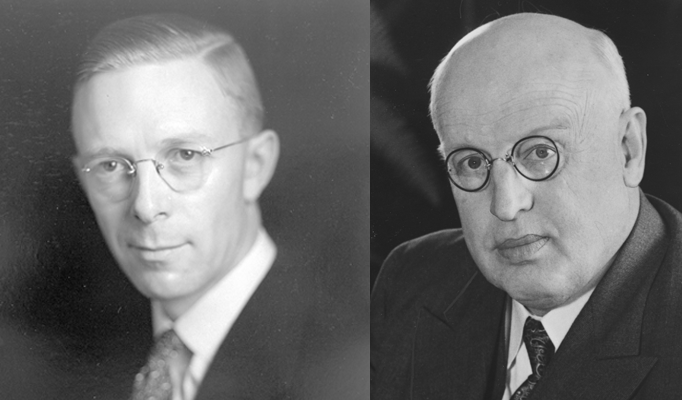
Whom were the only radio evangelists to become provincial premiers in Canada? William Aberhart and Ernest Manning have that distinction. Aberhart, known as Bible Bill, served as the seventh Premier of Alberta from 1935 to 1943. Ernest Manning was the eighth Alberta Premier from 1943 to 1968.
Born in Ontario, Aberhart had attended a Presbyterian Sunday School, giving his life to Christ as a teenager. He served as principal in three schools from 1905 to 1935. Having an almost photographic memory, he relied heavily on rote memorizing for his teaching, preaching, and politics.
While at Zion Presbyterian Church in Brantford, Ontario, he applied unsuccessfully to train for four years to become a Presbyterian minister at Knox College. Because he was already married with children, this was seen by the local presbytery as too great of a financial burden.
Influenced by his hero DL Moody, he became fascinated with biblical prophecy and the book of Revelation through his taking C.I. Scofield’s correspondence course. He believed that ‘prophecy was history foretold. History was prophecy fulfilled.’ For a while, after moving to Calgary in 1911, he taught the bible in Grace Presbyterian Church. After that door closed, he briefly was involved with the Methodists before becoming a lay preacher in 1915 at Westbourne Baptist Church. Thomas Underwood, the former mayor of Calgary known as Mr. Baptist, complained about Aberhart who had not yet experienced adult baptism. Why, Underwood said, should a non-Baptist be preaching in a Baptist church? One Sunday the Westbourne members found themselves locked out of their own church building by the trustees from First Baptist Church. The church doors however were forced open and the services resumed. Aberhart’s bible class, which met on Thursday evenings, attracted so many people that Westbourne Church could no longer hold it. They temporarily moved to the Calgary Public Library, renaming themselves the Calgary Prophetic Bible Conference.
Aberhart also was a gifted dramatist, one of his most popular plays being ‘The Branding Irons of the Antichrist.’ Lloyd Mackey described Aberhart’s passionate preaching,
…Aberhart would begin speaking quietly enough, but his voice would rise to a crescendo. His jowls would shake, and his eyes would enflame as he punctuated his speech with finger-pointing and podium-slamming. He was, in short, a spell-binder.
Aberhart, though a teetotaler, died at age 64 from cirrhosis of the liver, due to obesity and diabetes. Surprisingly, Aberhart’s funeral and burial occurred in Vancouver BC rather than Alberta. At the funeral, Ernest Manning said: “Above all else a devout Christian, Mr. Aberhart was known and loved by thousands as one of the greatest Bible teachers of this day and age.”
Ernest Manning, who lived in Rosetown, Saskatchewan, was led to Christ at age 18 in 1926 through Aberhart’s radio preaching. Aberhart taught Manning the difference between knowing about Christ and knowing Christ personally.
(Aberhart) brought about a complete transformation in my life. My interests changed, my outlook on life changed, and one of the very first major differences in outlook that came about as a result of that personal acceptance of Christ was an almost insatiable desire to know more about the Scriptures. That was the source of knowledge about Him. Everything spiritual that we know, we get from the Scriptures. – Ernest Manning
Manning ended up becoming the first graduate in 1930 from Aberhart’s Prophetic Bible Institute. During his second and third years at the Institute, he lived at the Aberhart home. There he met his future wife, Muriel Preston, who was the institute’s pianist and later served as the National Back To The Bible radio musical coordinator. Aberhart said in later years that he saw Manning as the son he never had. After graduation, Manning became a teacher at the Institute, preached on Aberhart’s radio program, and helped organize the Institute’s business affairs. His son Preston Manning commented, “Aberhart had an analytical mind and a genius for organization. My father also had an analytical mind and an administrative talent…”
Their radio broadcast was carried on over ninety stations from Halifax to Vancouver, reaching 600,000 listeners at its peak. Remarkably, they were on the air for four hours every Sunday afternoon in three separate sessions. More people listened to Aberhart and Manning on the radio than even the highly popular comedian Jack Benny. Manning consistently said on air that “Man’s only sure hope in this insecure world is to make God his refuge and the infallible scriptures his guide.”
Manning mimicked Aberhart’s radio delivery so effectively that he became known as ‘the Echo.’ Despite the similar radio presentation, Manning said, “I think I’m quite truthful in saying that our personalities were fundamentally different. We were different types of people altogether.” Lloyd Mackey commented, “Aberhart was combative; Manning went out of his way to avoid arguments – but he was no patsy.” Aberhart was known for ‘scaring the hell’ out of his listeners. Manning commented,
For Aberhart, ‘there were no grey areas – it was black or white, you are for me or against me…My approach was not that way. I think I could be just as adamant in standing for what I felt was right and necessary, but I never got any satisfaction of making somebody mad if you could gain your end by more congenial means. I have always thought there was a great deal of truth in the old philosophy that says the greatest victory you could have over any enemy was to make him your friend.
In 1920, Aberhart created the Radio Sunday School Mission, which sent correspondence lessons to children across Western Canada and the northern United States. By 1939, more than 9,000 children were actively enrolled in the program.
Aberhart and Manning told their radio listeners that they had a Christian obligation to look after the material as well as the spiritual needs of their families, neighbours, and friends, especially during rough times. When the Great Depression hit, many Canadians turned to socialism. Aberhart said that the suffering of people during the Depression almost made him become a communist. Aberhart instead turned to the British Major Douglas theory of social credit. Aberhart and Manning called it ‘applied Christianity’, offering a $25 monthly ‘dividend’ to each Albertan. Social credit, Aberhart told his radio listeners, was a way of throwing the moneychangers out of the temple. Ernest Manning said: ‘It was a Christian motivation that put us into politics. I had no desire to go into politics, and I know (Aberhart) didn’t.’ Manning was surprised by the response, commenting,
We’d go into some little places with a population of maybe a thousand or twelve hundred people, and it wouldn’t be unusual to get two thousand people out for a meeting. They’d come fifty or one hundred miles.
Despite sweeping into power provincially winning 53 of the 66 seats, Aberhart’s twelve social credit statutes were all defeated. Many were declared unconstitutional by MacKenzie King’s federal government. In 1936, Aberhart introduced Prosperity Certificates, known as ‘funny money’ which many businesses refused to accept.
At age 34, Manning was not only the youngest premier in Alberta history, but also the youngest in the British Commonwealth. He won seven consecutive elections, being Alberta’s longest serving Premier and the second longest serving Premier in Canada. Starting in 1970, he was the only member of the Social Credit Party to serve in the Canadian Senate. He was also open about his Christian convictions, saying “Your number one concern in life should be your personal relationship to Jesus Christ. He’s the sovereign Lord of everyone.”
Preston Manning described the social credit philosophy as a mixture of ‘pre-Keynesian economics, social resentment, and untutored hope.’ While not all Socreds were Christians, Ernest Manning said that ‘stable Christian men and women with very firm Christian convictions, perhaps more than anything else, gave stability to the movement.’ ‘O God Our Help in Ages Past’ was the Social Credit theme song. At the Socred picnics, they would sing ‘What a Friend We Have in Jesus.’
Premier Peter Lougheed spoke of
…how Manning and his government’s policies transformed Alberta from a have-not province into an economic powerhouse…Alberta’s oil and gas industry infrastructures began with Ernest Manning and still bears his imprint.
Under Aberhart and Manning, Alberta experienced times of significant economic and spiritual renewal. May their examples inspire other Canadians to make a difference as salt and light in the public square.
 Books by Rev. Dr. Ed & Janice Hird include God's Firestarters; Blue Sky, a novel; and For Better, For Worse: Discovering the keys to a Lasting Relationship. Dr Ed’s newest award-winning book The Elisha Code is co-authored with Rev. David Kitz. Earlier books by Dr. Ed include the award-winning Battle for the Soul of Canada, and Restoring Health: Body, Mind, & Spirit.
Leave a Reply