
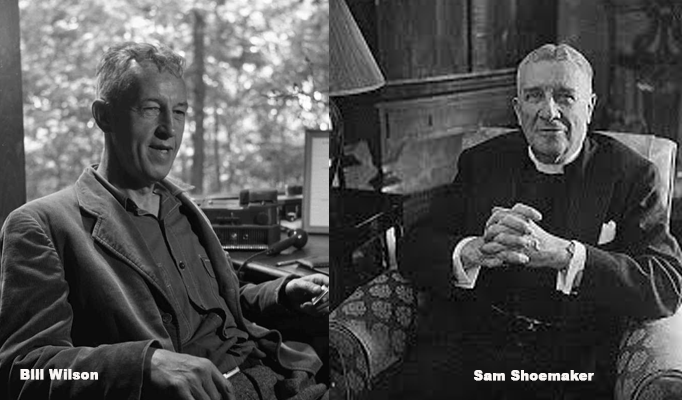
From 1917 until 1919, Sam Shoemaker served as a YMCA missionary in China. In January 1918, Sam met a fellow missionary to China, Frank Buchman, founder of the Oxford Group where he experienced a profound spiritual renewal through the “Four Absolutes” of honesty, purity, unselfishness, and love. Absolute Purity means to find some all-consuming and high faith and purpose which takes up and uses one’s energies. Shoemaker always said that “we should believe the incredible and tackle the impossible.” He memorably noted that “…everyone has a problem, is a problem, or lives with a problem.”
Billy Graham called Shoemaker “a giant among men… I doubt that any man in our generation had a greater impact on the Christian world than did Sam Shoemaker.” Billy Graham saw Shoemaker as the single, most dynamic preacher of his day.
Ordained as an Anglican/Episcopal pastor in 1921, he served as Rector of Calvary Church, New York, from 1925 to 1952.
As Bill Wilson tells it in AA Comes of Age, he went in December 1934 with his friend Ebby to Dr. Sam’s Calvary Church Mission:
There were some hymns and prayers. Then Tex, the leader, exhorted us. Only Jesus could save, he said. Somehow this statement did not jar me. Certain men got up and gave testimonials. Numb as I was, I felt interest and excitement rising. Then came the call. Some men were starting forward to the rail. Unaccountably impelled, I started too…I knelt among the shaking penitents. Maybe then and there, for the first time, I was penitent too. Something touched me. I guess it was more than that. I was hit. I felt a wild impulse to talk. Jumping to my feet, I began…Ebby, who at first had been embarrassed to death, told me with relief that I had done all right and had ‘given my life to God.’
Wilson and his wife Lois started attending Oxford Group meetings at Calvary House with Sam Shoemaker. Shoemaker became one of Wilson’s closest personal friends, even hosting the first AA meetings in his Calvary Church Hall. Both Shoemaker and Wilson had a wonderful sense of self-deprecating humour that drew the non-religious to God. Shoemaker often said: “I never feel quite as much at home as I feel at an AA meeting.” A woman said to him: “Sam, you may not be an alcoholic, but you certainly do talk like one of them.” AA now has over two million members worldwide, with more than 123,000 groups in about 180 countries. So many have gotten their lives back.
Where did AA’s amazing 12 Steps come from? They were written by Bill Wilson. Thinking of the twelve apostles, he decided that the society should have twelve steps. Dr. Sam, as he was known affectionately in AA circles, had a profound impact on Wilson’s spiritual awakening. The divorce of Wilson’s parents when he was aged ten was a shock that he never forgot. He says he remained depressed for almost a year following his parents’ divorce. He ended up staying with his grandparents after his mom left for Boston to attend Osteopathic School. Wilson’s pain was heightened by the fact that he did not see his father again for nine years.
Wilson said that ‘It was from Sam that co-founder Dr. Bob and I in the beginning absorbed most of the principles that were afterwards embodied in the Twelve Steps of Alcoholics Anonymous, Steps that express the heart of AA’s way of life.’ Wilson went on to say that Dr. Sam ‘gave us the concrete knowledge of what we could do about (alcoholism)’ and that Dr. Sam ‘passed on the spiritual keys by which we were liberated’. Shoemaker, according to Wilson, ‘has been the connecting link.’
Before AA, they would just put people in sanitariums because they didn’t know what to do with them. AA showed how alcoholism is a disease with a spiritual solution. Even though Shoemaker was not an alcoholic, he had unusual insights into the human condition that drew alcoholics to him. Reminiscing about the first time that he met Shoemaker, Wilson said: ‘I can still see him standing there before the lectern. His utter honesty, his tremendous forthrightness, struck me deep. I shall never forget it.’ Shoemaker according to Wilson, “always called a spade a spade, and his blazing eagerness, earnestness, and crystal clarity drove home his message point by point…Here was a man quite as willing to talk about his own sins as about anybody elses’.”
The author of 28 books, Shoemaker was named as one of the ten greatest preachers in North America. He founded several movements, including Faith at Work in 1926 and the Pittsburgh Experiment in 1955, which integrated business and faith. His wife Helen, who wrote Shoemaker’s biography I Stand at the Door, birthed the Anglican Fellowship of Prayer in 1958. He challenged all of the failings of humanity with fierceness, wit and relevancy. But Shoemaker was never pessimistic or despairing. Like Wilson, Shoemaker never gave up on people.
There are now dozens of recovery groups who apply the 12 Steps to all kinds of addictions and challenges, including overeating, narcotics, sexual brokenness, emotional dysfunctions, and gambling dependencies. Lois, Bill Wilson’ wife, birthed Alanon, which focuses on the families and spouses of alcoholics. There is even a specifically Christ-centered expression based on the beatitudes called ‘Celebrate Recovery’ that over five million people have already participated in over 35,000 host churches.
Since 1982, I (Ed) have done hundreds of Fifth Steps where people have come into great freedom from alcoholism and drugs. Many have encountered the Holy Spirit as their higher power. When we admit that we have wronged others and then make restitution, miracles can happen. Families are often restored after years of rejection.
Many 12 Step groups around the world pray both the Serenity Prayer and the Lord’s prayer. Both prayers are about ‘letting Go and letting God’. According to Wilson, breakthroughs happen when “…we can surrender and truly feel, ‘Thy will, not mine, be done’.” It is so hard to let go. Yet as we work the 12 steps, as we admit our powerlessness, as we turn our lives and will over to the care of God, as we seek only for the knowledge of God’s will, then miracles can happen.
As Shoemaker said to the 20th Anniversary AA Convention,
Prayer is not trying to get God to change His will. It is trying to find out what His will is, to align ourselves or realign ourselves with His purpose for the world and for us. When we let willfulness cool out of us, God can get His will across to us as far as we need to see ahead of us. Dante said, ‘In His will is our peace’.
Shoemaker concluded his address to the 20th Anniversary AA Convention by saying:
I thank God that the church has so widely associated itself with AA, because I think AA people need the church for personal stabilization and growth, but also because I think that the church needs AA as a continuous spur to greater aliveness and expectation and power.
“Perhaps the time has come”, said Shoemaker, “for the church to be reawakened and revitalized by the insights and practices found in AA.”
Our prayer for those reading this article is that as with Bill Wilson and Sam Shoemaker, God may make each of us a channel of his peace, his serenity and his sobriety.
 Books by Rev. Dr. Ed & Janice Hird include God's Firestarters; Blue Sky, a novel; and For Better, For Worse: Discovering the keys to a Lasting Relationship. Dr Ed’s newest award-winning book The Elisha Code is co-authored with Rev. David Kitz. Earlier books by Dr. Ed include the award-winning Battle for the Soul of Canada, and Restoring Health: Body, Mind, & Spirit.
Leave a Reply