
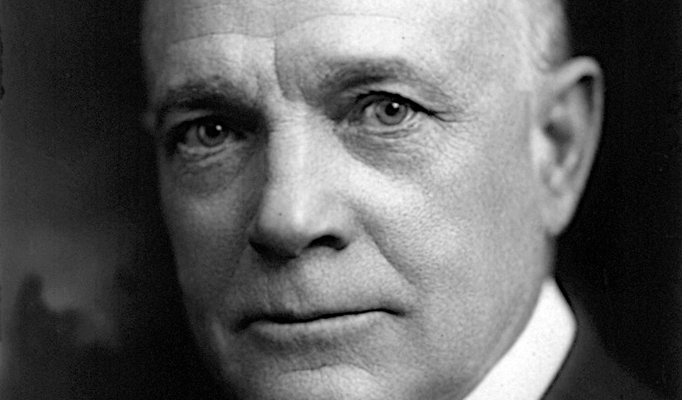
Before Billy Graham, there was Billy Sunday. Historians describe Billy Sunday as an early 20th Century Billy Graham. Ironically Billy Graham gave his life to Christ at a Mordecai Ham meeting that had been inspired by Billy Sunday’s example. Billy Graham’s Hour of Decision radio program was recorded in the Billy Sunday Tabernacle in Winona Lake, Indiana.
Billy Sunday was born on November 19, 1862 during Abraham Lincoln’s presidency in Story County, Iowa. The family name Sonntag (day of the sun) was anglicized to “Sunday” by his grandparents after they immigrated from Germany and settled in Chambersburg, Pennsylvania. His Union Army father William Sr. died from pneumonia after crossing a partially frozen river. This left baby William (Billy) fatherless. After his alcoholic, violent stepfather James Heizer abandoned Sunday’s mom Jennie, she sent him to a Soldiers orphanage at age nine. Five years later, after a second orphanage and briefly returning home, he ran away and worked for Colonel John Scott in Nevada, Iowa, as a stable boy looking after Shetland ponies.
Baseball fascinated Sunday. By 1880, baseball had completely captivated America. Despite his being struck out the first thirteen times at bat, Sunday played professional baseball for eight years for Chicago, Pittsburgh, and Philadelphia. His remarkable speed in running the bases was his trademark. At one point, Sunday raced Arlie Latham, champion sprinter of the American Baseball League, beating him by fifteen feet. One evening in 1886, after a night of drinking with his baseball teammates, Sunday stumbled upon a Pacific Garden Mission street meeting. His life was powerfully transformed by hearing them sing his mother’s favorite hymns.
After winning the reluctant approval of his future father-in-law William Thompson, he married Helen Thompson in 1888. Baseball players, with their alcoholism and carousing, were not seen as respectable marriage options in those days. His wife Helen ultimately became his Crusade campaign manager, helping protect him so that he could actually take a break.
His first YMCA sermon, “Striking Out Satan” (Feb. 14, 1889) – attracted hundreds, with 48 people giving their lives to Christ. In 1891, Sunday left professional baseball to become a full-time YMCA worker. He gave up a well-paid salary of $2,000 per year with the Philadelphia ball club for a precarious one of $1,000 with the financially strapped Chicago YMCA. An ordained Presbyterian minister, Sunday was one of the first clergy to make use of the amazing ‘new’ medium of radio. His messages were casual, anecdotal, and visually dramatic. Before the advent of TV and movies, he was ‘the best show in town’, exciting, unpredictable and unforgettable.
Sunday would sometimes have a baseball game with attendees before proceeding to hold a revival service. Occasionally during a sermon, he would dive across the stage and visually slide into home plate. Then he might stand up and challenge men to ‘come up to the plate’, to stand up for their wives, children, church and country. Sunday broke the stereotype that church is only for women and children. He strongly challenged men to play their part, to be part of God’s team, to get involved. Reminiscent of the frontier preachers in the earlier Wild West, he publicly confronted crime, vice, immorality, and bootleggers,
“When I started out to preach, I was, and still am, the uncompromising foe of the forces that crush human hearts, blight lives, feed the flames of lust and passion, brutalize their minds with opiates, sell their souls for rum and cause them to sow the seeds that product the harvest of misery for themselves and tears of sorrow for their loved ones.” – Billy Sunday
Following the collapse of his Gospel tent in 1905 from three feet of snow, Sunday began using wooden tabernacles he built for his evangelistic services. The wood would later be resold to pay for the expenses of the outreach. His New York Tabernacle was large enough to seat over 18,000 people. It took two train carloads of red-cedar sawdust to cover the vast tabernacle floor. Sawdust, which made the floor quieter and cleaner, was originally used by loggers to find their way back home through thick forests. Sawdust in crusades became symbolic of people finding their way back home to Christ. In Philadelphia, Pennsylvania, after ten weeks of meetings at the Billy Sunday Tabernacle, people put sawdust in their pockets as mementos of the great revival.
Sunday and his team would simultaneously give addresses to business gatherings, men’s meetings, factories, street missions, prisons, and children. Around the third week of the Crusade, there would be a Sunday School parade. In Wilkes-Barre, Pennsylvania, twenty thousand children marched carrying banners and flags, with at least thirty thousand more turning out to watch. The procession was four miles long, marching four, and sometimes eight abreast.
Sunday observed first-hand that ‘nine-tenths of the misery, wrecked homes, and blighted lives were caused by booze.’ The liquor industry, with its 218,000 American saloons, actively campaigned against Billy Sunday’s crusades as it was bad for their business. Because many women had suffered so greatly from their husbands’ alcoholism, they teamed up with Billy Sunday to bring about Prohibition from 1920 to 1933 with the 18th Amendment. By contrast, in Canada, there was only national Prohibition from 1918 to 1920, being overturned in BC in 1920 and in Alberta in 1924.
With his wife Helen, Sunday held massive women’s only gatherings that were so popular that in 1916, 20,000 women in Detroit, Michigan, broke down doors to get access. Sunday publicly endorsed women’s suffrage, stating in the 1918 Washington Herald,
“If she is good enough to be our mother and our wife, good enough to preside over our home, to care for us in times of sickness and to share our joys and our sorrows, why should she be denied the privilege of voting?” – Billy Sunday
As an orphan sent away by his destitute mother, Sunday was both courageously resilient and emotionally fragile. His only daughter, Helen, wrote to her dad, ‘Even with all your wonderful success and high place, you always seem like a little boy to me – a little boy, who needs comforting and loving.’ He had a deep fear of losing his wife Helen. The mere thought of life without Helen (Ma) could make him physically sick,
“Say Ma, don’t you go to Heaven first. I couldn’t stay if you were gone and the children gone. I surely love you and home too, but rugs and chairs and pictures can’t talk and comfort you.” – Billy Sunday
During Sunday’s lifetime, over one hundred million people heard him speak, more than any other preacher to that point. He often spoke without any PA system. Over 1.25 million people publicly responded to his challenge to dedicate their lives to Christ, to ‘come up to the plate’ and stand up for their families and God. He wanted people to make a public decision, saying yes to Christ: “Your success in life tomorrow will be determined by what you said ‘yes’ or ‘no’ to today.” He trained up teams to do follow-up with the many converts. Billy commented, “They tell me revival is only temporary. So is a bath, but it does you a lot of good.”
Those who came forward to shake Sunday’s hand would be given a pamphlet explaining how to receive and then grow in Christ,
“A Christian is any man, woman or child who comes to God as a lost sinner, accepts the Lord Jesus Christ as his personal saviour; surrenders to Him as his Lord and Master; confesses Him as such before the world and strives to please Him in everything day by day. Study the Bible; pray much; win someone for Christ; shun evil companions; join some church; give to the support of the Lord’s work and don’t get discouraged.” – Billy Sunday
The news media was fascinated by Billy Sunday, giving him more coverage than American Presidents,
“No man is more indebted and more grateful than I to the newspapers for their aid in helping me to spread the gospel to millions who have never seen my face. No one can see more quickly through a fraud, or rise more quickly to genuine sincerity, than newspaper men and women. I have never had one double-cross me. My prayer for 40 years has been, ‘God bless the newspaper editors and reporters, typesetters, and the newsies who sell on the streets.’” – Billy Sunday
As a consummate story-teller, Sunday had a serialized autobiography in the Ladies Home Journal in late 1932 and early 1933. His friend President Theodore Roosevelt wrote that he saw Billy Sunday as the foremost reformer in the United States.
The high point of his outreach was in New York City, known as the graveyard of the evangelists. Almost 100,000 New Yorkers gave their lives to Christ during those ten weeks in 1917. On the final night, Sunday told people that he would contribute the closing free-will offering of $120,485 (the equivalent of over three million dollars nowadays) to the American Red Cross and the YMCA/YWCA for their service to America’s soldiers fighting in Europe.
After Sunday died of a heart attack in 1935, his wife Helen continued to travel, giving her testimony. Billy Graham invited her to speak at his 1950 Atlanta Crusade. She survived her husband by more than two decades. There was a lot of tragedy with their children, all of whom died before their mother, the sons from alcoholism, a plane crash, a car crash, and suicide. Her daughter Helen Jr died from muscular dystrophy in 1931.
Through Billy & Helen Sunday, love has broken through for countless tens of millions of families. May God’s love break through for you and your loved ones.
 Books by Rev. Dr. Ed & Janice Hird include God's Firestarters; Blue Sky, a novel; and For Better, For Worse: Discovering the keys to a Lasting Relationship. Dr Ed’s newest award-winning book The Elisha Code is co-authored with Rev. David Kitz. Earlier books by Dr. Ed include the award-winning Battle for the Soul of Canada, and Restoring Health: Body, Mind, & Spirit.
Rev. Dr. Ed & Janice Hird: I greatly appreciate each summary you make of a Christian Leader’s life and ministry. They each have struggled and have overcome. Some of us in this generation did not know about them. They have become examples to us Christians to offer to God our lives and abilities for him to empower and use for His Glory.
Thank you,
Ruth Young